I built a wallpaper generator. It runs entirely in the browser, exports at any resolution, and has sixteen different styles — from layered waves to low poly meshes to a fully animated particle system. No sign-up, no watermark, no cost.
Here it is.

I built a wallpaper generator. It runs entirely in the browser, exports at any resolution, and has sixteen different styles — from layered waves to low poly meshes to a fully animated particle system. No sign-up, no watermark, no cost.
Here it is.
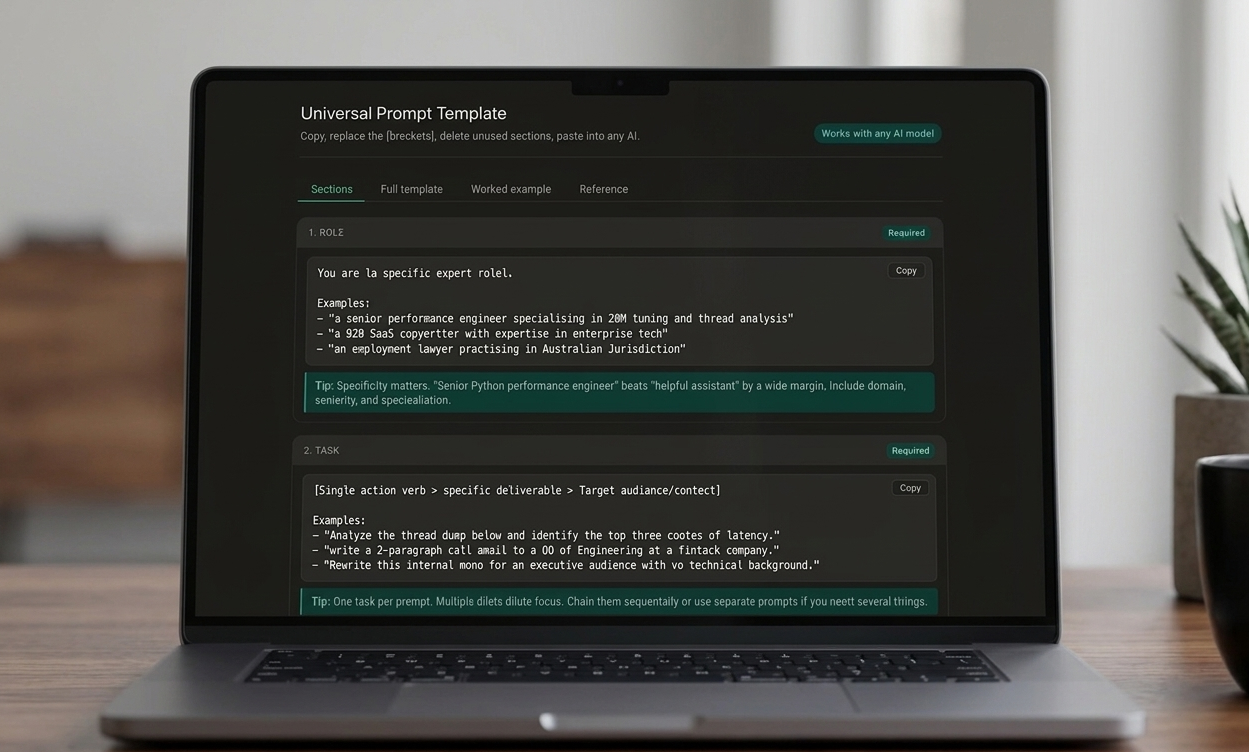
Most people use AI the same way they used Google in 2007 — a few words typed into a box, hoping for the best. It works well enough to become a habit. It does not work well enough to be useful for anything that actually matters.
The difference between a prompt that produces something genuinely useful and one that produces something you have to rewrite entirely is mostly structure. Not magic words. Not special techniques. Just the habit of telling the model what it needs to know before asking it to do something.
There is a version of this conversation that is entirely about aesthetics — white walls, linen wardrobes, the satisfying emptiness of a well-curated bench. That version is fine, but it is not particularly interesting. The more interesting version is about money, time, and the quiet decisions that compound over years into a life that either belongs to you or to the things you keep acquiring.
Minimalism, at its most useful, is not a design movement. It is a financial strategy disguised as a lifestyle.
There is a number that keeps coming up in conversations about electric vehicles and renewable energy, and most people are not ready for it. One in four new cars sold globally right now has a plug. Not in Norway, not in some optimistic forecast — globally, right now, in 2026. That number was essentially zero fifteen years ago.
The transition is not coming. It is already underway, and it is moving faster than almost anyone predicted.
On the evening of 10 April 2026, a capsule called Integrity dropped into the Pacific Ocean about 50 miles off the coast of San Diego. Inside were four people who had just done something no human had done since December 1972 — travelled to the vicinity of the Moon and come back.
There is a scene in Top Gun: Maverick where Pete Mitchell pulls off a manoeuvre that is physically impossible and saves his squadron. The crowd in the cinema cheered. It is a genuinely thrilling film. It made a billion dollars in its opening month. Navy recruiters set up tables outside theatres specifically to catch people walking out still buzzing from the adrenaline.
(more…)There was a poster of the New York skyline on the bedroom wall. The Twin Towers were still standing in it. It stayed up for years.
(more…)Linkin Park played Sydney a few days ago. Two nights at Qudos Bank Arena, their first time back in Australia since 2013. The city was ready for it — both shows sold out almost immediately when tickets dropped, and a third date was added just to meet demand.
(more…)There is no shortage of opinions about sugar on the internet. Every second article is either telling you it is slowly killing you or reassuring you that everything in moderation is fine. Nutrition discourse online has become its own kind of exhausting — everyone has a framework, a study, a strong feeling, and an unwavering confidence that theirs is the correct one.
(more…)